Showing posts with label stream buffer. Show all posts

Wednesday, March 20, 2013

Pileated Woodpecker


While I was taking pictures of the skunk cabbage at the edge of the wetland one day last week, a pileated woodpecker noticed me and started making a show of hopping up the trunk of a nearby tree.


Pretty soon all was quiet when the bird flew from the tree and disappeared.  But I had that eerie feeling that I was being watched,  Sure enough, what I first thought was the pointy stub of a branch on the side of a tree was actually the woodpecker peeking out of a hole.  I couldn't believe how lucky I was to stumble across this surprise -


That vertical gash on the right side of the trunk is the entrance to a cavity in the tree.  The combination of the low light of approaching dusk and my feeling that I needed to take a quick picture and back off meant I ended up with a disappointingly blurry shot of the opening.


I beat a hasty retreat because I really didn't want to disturb this bird, especially if it has eggs in that hollow.  As I left, the woodpecker flew out of its hole to keep an eye on me.


I discovered a very surprising fact about pileated woodpeckers on the National Audobon webpage devoted to them -

This species requires late successional stages of forest for habitat, as well as younger forests that have scattered, large, dead trees for food, nesting, and roosting. In younger forests they requires larger areas: 3,904 acres of virgin forest supports 3-6 pairs of Pileated Woodpeckers, while the same area of secondary forest will support just one pair. They also require larger trees with dead centers for roosting, where the bird excavates only the entrance hole.


Can it really be that each pair of woodpeckers requires that much territory?  I saw a similar statement on a website  Pilleated Woodpecker Central  - 

Territory size varies between 1000 and 4000 acres.  They will defend their territory year-round.


According to the second website, predators of the Pileated Woodpecker include the Red-tailed Hawk (a pair of which used to annually lay eggs in a large nest located in a neighboring tree), Barred Owls (which we have been hearing at night recently), weasels, and squirrels, among other animals.  These are just the predators mentioned that I know are sharing this same corner of the wetland.  

And these woodpeckers are monogamous.  As in they remain with the same mate for life, not just for a mating season.  That is cool.

Right after my chance discovery, our friend Jeff shared some beautiful pictures of a pileated woodpecker that visited his bird feeder located about two miles upstream from us.  Jeff gave me the go-ahead to share his photos here.


photo courtesy of Jeff S.


Photo courtesy of Jeff S.


Wednesday, March 13, 2013

Hello Spring 2013


Indian Plum (Oemleria cerasiformis)

Has it really been almost a year since posting on here?  Time to get back in the groove.  Suddenly watching the flora and fauna come alive around here has inspired me to get my blogging act together.


Just as a brief reminder - I started this blog in April of 2009 when Adopt A Stream lead a project to restore a native growth buffer along the banks of Little Swamp Creek where it travels through our yard.  Students from the Leaf School at Edmonds Community College helped plant and mulch the buffer here in two phases and helped install large woody debris in a couple places along the stream bank.  This work took place between April 2009 and April 2010. Adopt A Stream and The Leaf School also completed an additional restoration project in our neighbor's yard where the stream continues behind our property.  The plants in our yard are doing fabulously, with only a few becoming victims to varying degrees of deer and beaver.


Back to what is happening now.  Indian plum is one of the first native plants that we see blooming along Little Swamp Creek, but it's not the only native plant currently blooming here.  Skunk Cabbage is also popping up like mad.  I hadn't smelled it yet, but I sure saw a lot of blossoms in the wetland behind our fence.


Skunk Cabbage (Lysichiton americanus)

Little Swamp Creek in Swamp Creek Wetland #3

Another view of Little Swamp Creek in Wetland #3

A few spots of bright pink Salmonberry blossoms suddenly appeared along the stream,


which prompted me to share the signs of spring showing up in the native plantings along our little stretch of Little Swamp Creek.


Wild rose (maybe Nootka but not sure)


Salmonberry (Rubus spectabilis)


Twinberry (Lonicera involucrata)


This chokeberry is one of the first plants that we planted next to the stream. That was back in 2000.  It is now sporting a beautiful collection of lichens. 


This little nettle start and mushroom were part of the plant community on and around a huge, old tree stump that was left behind after this area was logged years and years ago.  There are several old stumps like this in the woods around us.


Red-flowering Currant (Ribes sanguineum)


I didn't realize how readily the Red-flowering Currants will multiply by establishing a new plant with root growth off of a branch that remains in contact with the ground.  Here's an example in our yard -


I took a picture of this willow next to the stream on one day, and the next day it was chopped down by a beaver.  More on the beaver issue in a future blog post...


Friday, November 11, 2011

Streamside Planting Update


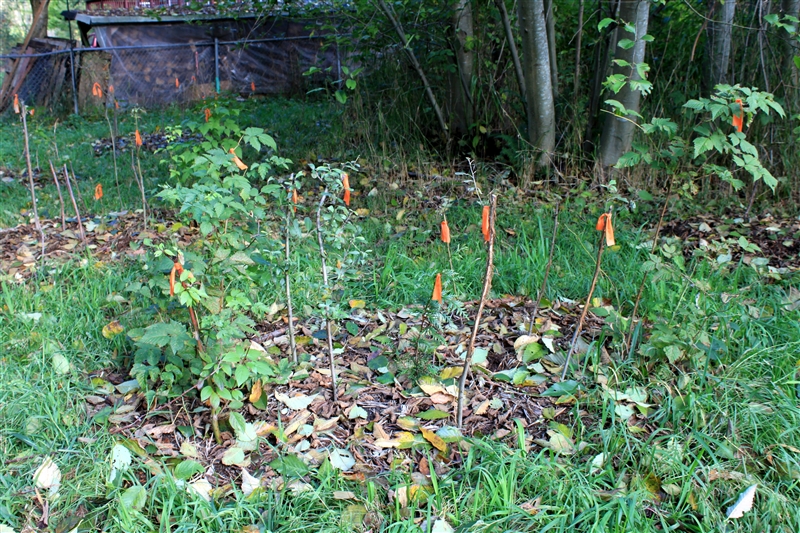
Here is a loooong overdue update of how the planting in the stream buffer behind our fence is doing.  Our friends at Adopt-A-Stream gave us some biodegradable surveying tape to mark the plants so they show up a little better in photos.  I marked everything I could find that is still alive, so here you go ---


Before - 11/2010


11/2011, a year after planting


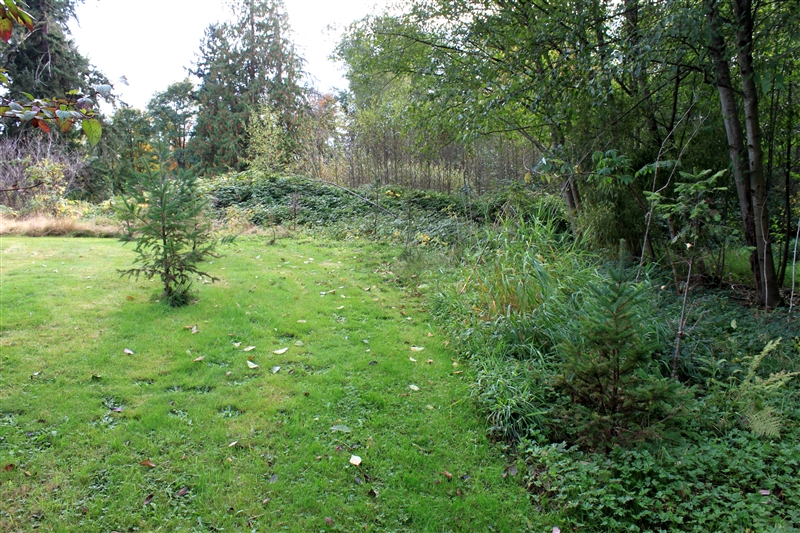
These next three shots are basically a panorama, starting with looking south across the large area next to the stream and ending up looking west toward the stream, which you can't see, but it is on the other side of the group of trees in the middle of the third shot -


Here is a view of this same area but looking northeast, right after planting last year -


...and here it is now - 


The reed canary grass is obviously still here, and the plan for our neighbor to mow between the beds to keep it down didn't pan out, mostly because it is so sloppy wet in this area.  Eric went back there with a string trimmer periodically, and I pulled grass runners out of the beds this fall.


Here are shots of various planting beds.  Unfortunately the live stakes are loosing their leaves due to fall and a bunch of the willow leaves have been nibbled by deer, so it will be hard for you to tell how well they are doing.  Keep in mind that everything marked with orange tape is living - 


Here's an example of what these beds started out looking like a year ago -


Here are some of the live stakes that were poked in along the stream bank.  And a peak-a-boo shot of the stream -


This is looking toward the southern boundary of the planted area.  There are a lot of surviving live stakes here -


 Here is the view standing uphill and looking west.  I'm concerned about the blackberry vines from the neighboring property overwhelming this area -


Same area right after planting


Poor little Douglas Fir being surrounded by blackberries

These next three shots are of the part of the project that is the furthest away from the stream - 


Right after planting

The blackberries are definitely returning to this area, too, which is the only bummer I see back there behind the fence.  I know from the way the new plants have grown along the stream in our yard that this project is going to look incredible in another year or two.

And speaking of which, I have a bunch of pictures to share of how amazing the stream-side restoration in our yard looks now.  I will share those in a separate post.  Soon!  

Sunday, October 23, 2011

Upstream Development


One of the most disappointing sounds to hear as a person who cares about the well being of a stream is the sound of earth-moving equipment working in the vicinity of the stream.  Unfortunately for Little Swamp Creek and for the peace and quiet of our neighborhood, a long-dormant proposed development named West Creek Village on 80th north of 192nd evidently was picked up by someone new and is moving full speed ahead.


At first there wasn't even a Notice of Construction Activity sign on the property.  It's disconcerting what requirements just might not happen until someone points out that they are missing.  THAT is as good a reason as any why people need to speak up.  About anything.  After it was pointed out to the city, the sign showed up right away...


First clue that something was up?  Hundreds of these dump trucks with trailers dumping loads of dirt on the site all day long for days.   By the way, the large trees on either side of this driveway are now gone...


I call the mound of dirt that they brought in "The Kenmore Matterhorn".   I was pretty excited to see a chance for a photo with a person on the pile for scale.  See him?  It's unbelievable that all of that dirt is really going to be used here.

When I went down to the city to see what was going on and point out the lack of an information sign, they were kind enough to give me a map of the project and mark on it where silt fencing should be.  The silt fencing is supposed to keep muddy runoff from flowing right into the stream.  I have to say that so far it seems to be doing an excellent job.


But on October 3rd we just happened to notice that the stream looked like this in our yard -


There was an excavator and other equipment working where the stream flows through the project property (see them behind the trucks on the right) -


and the stream immediately upstream from this project was sparkly clean -


Luckily the city contact person has been excellent in getting right back to us when we have had concerns, and that day he whipped right out to the site to check it out.  Evidently the project required a temporary diversion of the stream to build a new stream-crossing, and it was all done with the proper permits.  I'm not sure why this is OK at the time of year when salmon are returning....seems like it should have been done in the summer.  A few days later the city contacted us to warn us that the project was going to take the stream out of the diversion and that there might be silt in the water again.  We appreciated the warning.  


This is a picture taken today.  You'll notice that the massive dirt pile has shrunk.  Some of it must have been used to raise up the grade of the entry road, since that has now less of a dip. The cement walls are evidently where the stream runs under the access road.  Someday I'll walk down there to take pictures of the stream, but surprisingly enough there was someone riding around the property on a golf cart today, so I stuck to the street....


Posted by Picasa